FUNDING GUIDE
How to fund companion care for an elderly relative.
8 minute read · Updated April 2026
Most families assume companion care is something they’ll have to pay for entirely out of pocket. It’s often not true. Direct payments, Attendance Allowance, social prescribing, and personal health budgets all offer routes to funded support, and many families are entitled to help they’ve never applied for. This guide explains each option clearly.
When people start looking into companion care for an elderly parent, cost is usually the first thing they worry about. At £35 an hour, 8 hours month adds up to around £280 a month a meaningful amount, even for families who are comfortable.
What many don’t realise is that several routes exist to cover some or all of that cost through government funding, local authority budgets, or NHS programmes. The application processes aren’t always simple, but they’re worth understanding before you assume you’re paying privately.
Here’s a clear overview of every realistic funding option available in England in 2026.
The four main funding routes
ROUTE 01 · MOST RELEVANT
Direct payments from your local authority
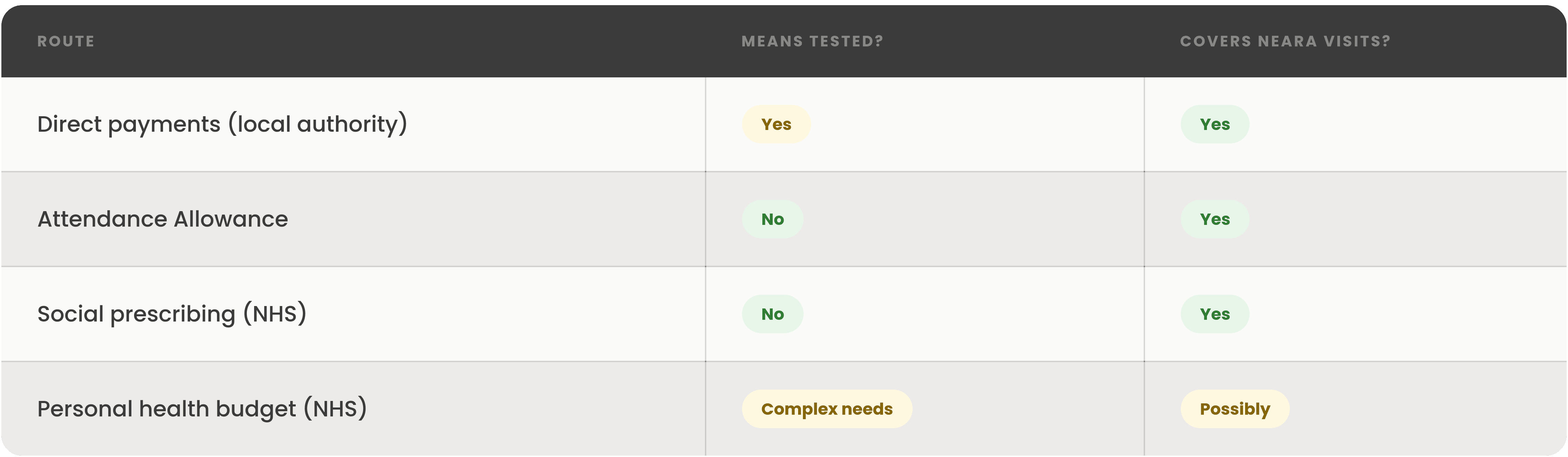
If your loved one has been assessed by their local authority as having eligible care and support needs, they may be entitled to a personal budget - money from the council to pay for the support they need. Direct payments are one way to receive that budget: cash paid directly to the individual (or a family member on their behalf), which can then be used to purchase approved care and support services.
Companion visits, including Neara visits, can be funded through direct payments, provided they form part of an agreed support plan. The key is that the visits must meet an identified need, such as reducing social isolation or supporting wellbeing.
How to apply:
01
02
03
ROUTE 02 · OFTEN OVERLOOKED
Attendance Allowance
Attendance Allowance is a tax-free benefit for people of State Pension age or over who need help with personal care or supervision because of a physical or mental disability. Crucially, it is not means tested, it doesn’t matter how much savings your relative has or what income they receive. Many families who would qualify have simply never applied.
There are two rates: £76.70 per week (lower rate) and £114.60 per week (higher rate), depending on the level of need. The higher rate could cover a significant portion of companion visit costs.
The money can be spent however the recipient chooses, including on companion visits. It doesn’t need to be used specifically for the care tasks that qualified them for it.
Who qualifies:
•
State Pension age or over (currently 66)
•
Has needed help or supervision for at least 6 months (or is terminally ill)
•
Is not already receiving Disability Living Allowance or Personal Independence Payment
•
Lives in England, Scotland, or Wales
ROUTE 03 · NO COST ROUTE
Social prescribing via a GP or link worker
Social prescribing is an NHS-backed approach that allows GPs and primary care teams to refer patients to non-clinical community support. It’s specifically designed for patients whose health is being affected by social factors, including loneliness and isolation, rather than (or alongside) medical conditions.
If your relative’s GP or a social prescribing link worker refers them to Neara, the visits may be funded through the prescribing programme at no cost to the family. Not all areas have the same provision, and availability varies, but it’s always worth asking.
To explore this route: ask your relative’s GP whether the practice has a social prescribing link worker, and whether a referral to a companion visit service would be appropriate.
ROUTE 04 · LESS COMMON
Personal health budgets (NHS)
A personal health budget is an amount of NHS money available to some people with long-term conditions or complex needs, to help them manage their health and wellbeing in a way that suits them. Unlike direct payments (which come from the local authority), personal health budgets come from the NHS and are typically available to people already receiving NHS continuing healthcare.
If your relative has been assessed as eligible for NHS continuing healthcare, a personal health budget could potentially be used to fund companion visits as part of their agreed care plan. This route is less common and requires an NHS continuing healthcare assessment, but is worth exploring for those with complex needs.
A quick comparison